
Our awareness of anger often does not occur until it is expressed in behavior. The anger when expressed is often brought to our attention by others. The impact of our anger on others may first be realized by the person who is the object of our anger. Have you experienced someone rather suddenly saying to you: “Why are you so angry!” You may be stopped in your tracks by the comment because you may not have been aware of the magnitude of your expression. Often others will see or experience the effect of our anger before we are aware. It is like a reflexive expression which may be instantaneous.
There are mysteries in anger expression. Let’s explore that. It seems to me that the process of anger, or what I would call the “Equation of Anger” has at least three parts. The diagram below will show this analysis. Hang with me and see if this makes sense to you.
The Anger Equation
Glenn C. Taylor
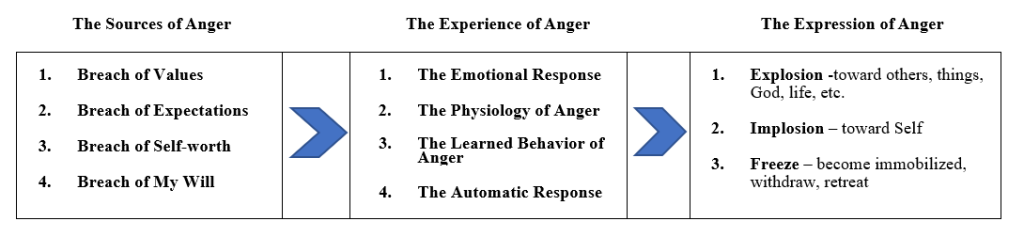
It is “The Expression of Anger” that gets the attention of other people. It may not get our attention immediately if our expression is reactive or the response activated by different kinds of provocation. It is rarely planned or a designed response. We vary greatly in expression. Some of us come to a “boil” slowly, others rather “instantly” hit the high temperature of expression. You probably can see yourself with variable responses which may be dependent on the context.
We also vary as to whether we explode, implode, or freeze. Identifying and acknowledging our typical response in different situations will be important in exploring our anger. To approach the subject with honest means we will have to avoid denial, which is another problem we will discuss later.
To explode is to express ourselves outwardly. To implode is to turn the anger inward toward self. To freeze is to become immobilized which often is expressed as “biting one’s tongue” and often indicates fear of expression. We may assess the situation as too dangerous to express ourselves in the way we would like to. I am sure you have been there! You quickly assess that to express would endanger your interests. Perhaps you will saves it for expression later or to someone who will accept or affirm your anger.
In the next blog, we will look at the “Experience of Anger” to understand the dynamic power which is the heart of the anger equation.
